Mainnet — 30 June 2026, 12:00 UTC

Green lightning,
mined anywhere.

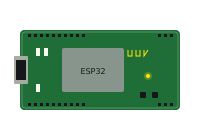
Volta is a Monero fork with a new proof-of-work — CryptoTiny — tuned so a $5 ESP32 microcontroller is a real miner, not a rounding error. Same privacy. One device, one vote.

$5
cost of a working miner — an ESP32 dev board
~0.5W
power draw per board, mining flat-out
120s
target block time
128KB
PoW scratchpad — fits the SRAM of any ESP32
From box to block

Mining, in three steps.

1 ~2 min
Flash the firmware
Grab the ESP32 sketch, open it in the Arduino IDE or PlatformIO, and flash your board over USB.
volta_miner.ino → ESP32
2 one line
Point it at a node
Set your Wi-Fi, the Stratum address of any Volta node, and the wallet address that should collect the rewards.
stratum = 192.168.1.10:3333 wallet = 5P4...your VLT address
3 forever
Mine
The board pulls work, hashes CryptoTiny, and submits shares — at about half a watt. Run a fleet off one USB hub and each household becomes its own mini-pool.
[ok] share accepted · 0.5 W
Under the hood

Monero privacy. New proof-of-work.

Proof-of-work
CryptoTiny
128 KB scratchpad · 512 sequential AES-128 rounds · Keccak-256. No floating point, no 64-bit multiply — built for the Xtensa core in an ESP32.
Base
Monero v0.18.3.4
RingCT, ring signatures, stealth addresses, Bulletproofs+ and view tags — active from block 1. Only the PoW is new.
Block time
120 s
Two-minute blocks, difficulty retargeting every block.
Units
12 decimals
1 VLT = 1012 atomic units, same precision as Monero.
Emission
0.3 VLT / min tail
Smooth Monero-shape curve with a permanent tail emission, so miners are always paid. No fixed cap.
Mining
Solo or P2Pool
Run a node and mine solo, or join Volta P2Pool — decentralized, no operator, no fee.
Premine
3,518 VLT · developer budget
One genesis allocation funds the domain, infrastructure and development. It is not hidden: the wallet's view key is published with the launch release notes, so anyone can scan every output and trace every spend on-chain. No second premine, no founder unlocks, no ICO.
One device, one vote

Mining farms get no edge.

CryptoTiny is memory-bandwidth bound and runs a fixed instruction stream, so a warehouse of GPUs or a custom ASIC gains only a small constant over the chip in your old smart plug. A thousand bedrooms, not a dozen data centers.

Get the firmware
mining esp32-shelf-01
height 41,920
6,144 H/s · 12 boards
~6.1 W total0.51 W / boarduptime 14d
[ok] board 04 — share accepted · diff 5,000
[ok] board 09 — share accepted · diff 5,000
[★] block found at height 41,920 · +0.6 VLT
[ok] board 01 — share accepted · diff 5,000
Illustrative dashboard — not live data.
Get Volta

Pick your platform.

Signed release binaries land at mainnet, 30 June 2026. Until then you can build from source and flash the miner firmware today — everything is in the public repository.

ESP32 miner
volta_miner.ino
Source
voltad + wallet · build guide
Volta P2Pool
decentralized pool node
Linux
x86-64 · aarch64 .tar.gz
● Available at mainnet
Windows
x86-64 .zip
● Available at mainnet
macOS
universal .dmg
● Available at mainnet
Straight answers

FAQ

Is this just another Monero clone?

It's a Monero v0.18.3.4 fork, so the privacy is Monero's — RingCT, ring signatures, stealth addresses. The one deep change is the proof-of-work: we replaced RandomX with CryptoTiny, a small memory-hard function that fits in an ESP32's SRAM. That's the whole point — to put mining back on hardware anyone already owns.

Can I really mine on a $5 chip?

Yes. CryptoTiny was designed around the ESP32's ~320 KB of SRAM and its hardware AES. A board draws roughly half a watt while mining. It won't out-hash a desktop, but the algorithm is built so the desktop's advantage is small and bounded — that's the "one device, one vote" goal.

Is there a premine?

Yes, and it's disclosed. A single genesis allocation of 3,518 VLT is the developer budget for the domain, servers and development. The wallet's view key is published at launch, so anyone can audit the balance and every spend on-chain. There is no ICO, no second allocation, and no founder unlock schedule.

When does it launch?

Mainnet genesis is 30 June 2026, 12:00 UTC. The genesis timestamp is baked into the binaries, so the chain literally cannot start before that moment — the launch is atomic for everyone.

How do I run a node or a pool?

Build voltad from source (the build guide is in the repo) and run it. To pool-mine, run Volta P2Pool alongside it — it's decentralized, has no operator and takes no fee. Default ports are 17080 (P2P) and 17081 (RPC).

Mainnet 30 June 2026

Get a board ready.

--days --hrs --min --sec
Get the firmware Read the source